Putting practice at home: drills that actually transfer
Putting practice at home is the cheapest way to save strokes, because putts are roughly 40 percent of the shots in a typical amateur round and you can work on them in your living room. A good putting stroke is small, so the room you need is small. This is what to practice, which drills are worth your time, and what a carpet cannot teach you.
Why putting is the cheapest strokes to save
Most swing faults take months to fix. Putting is different: the stroke is short, slow and simple enough to improve in weeks, and a stroke saved on the green counts exactly as much as one saved off the tee.
It is also the part of the game that survives indoors. A full swing needs a ceiling and a net. A putt needs a few feet of floor. If you are trying to break 100, three-putts are one of the biggest piles of strokes you can reach without changing your swing at all.
Setup and eye line
Most putting problems begin before the stroke starts. A few basics are worth checking once and then leaving alone.
- Eyes over, or just inside, the ball. From there you see the line the way the ball will roll it. Hold a ball at the bridge of your nose and let it drop: it should land on or near the ball you are about to hit.
- Shoulders level and relaxed. Hang the arms and let them form a simple triangle with the grip. A stroke from the shoulders is steadier than one from the wrists.
- Ball position that is the same every time. Usually a little forward of center. The exact spot matters less than not moving it.
- Quiet legs and head. Nothing below the shoulders should move during the stroke. Look at the spot where the ball was until it has gone.
The face at impact decides the start line
On a putt, the ball starts almost exactly where the face points at impact, and your path has far less to say about it than on a driver. A face that is a degree or two open or closed is enough to miss a short putt on the wrong side of the hole.
So the first thing to train is a square face through the ball, not a perfectly straight path. A stroke that swings slightly on an arc is fine, as long as the face comes back to square at the moment of contact.
Putting tempo: about 2 to 1
Putting tempo is a proportion, just like full swing tempo, but a different one. For most golfers the backstroke takes about twice as long as the through-stroke, so roughly 2 to 1. The three to one figure belongs to the full swing, not the putter. More on that proportion in golf swing tempo.
Two things matter more than hitting the number exactly. Accelerate through the ball. A stroke that slows down at impact twists the face and leaves putts short. And keep the stroke steady: a smooth, unhurried motion with no jerk at the top. Think of a pendulum, not a hit.
Distance control
More putts are lost to speed than to line. Distance control is mostly a matter of the length of the stroke, with a steady tempo. Keep the rhythm the same and let a longer backstroke send the ball farther, rather than hitting harder on a short one.
The through-stroke should be about as long as the backstroke. A short one usually means the putter stopped, and the ball comes up short.
Putting practice at home: five drills for a carpet
These work on any flat floor. Use a putter and a ball, with a coin or a cup as the target.
- The gate drill. Set two coins or tees a hair wider than the ball, about a putter-head in front of it. Roll the ball through without touching either. This trains the face and the start line more than anything else on the list.
- A coin or a cup as the target. A small target sharpens your focus. Putt from three feet and count how many you hole out of ten. Move back only when you make nine.
- The ladder drill. Place targets at, say, three, six and nine feet. Putt to each in order and try to stop the ball within a putter-length of it, without going past. This trains distance control.
- One-handed strokes. Putt with only your lead hand, then only your trail hand. It exposes a wrist that flicks or a hand that grabs, and teaches the arm and shoulder motion you want.
- Eyes-closed feel putts. Set up, close your eyes, make the stroke and guess where the ball stopped before you look. It trains feel for the stroke and speed over mechanics.
A ten-minute daily routine
A short routine is easier to keep than a long one, which is the point of a ten-minute daily routine. Here is one that fits in a hallway.
- Two minutes of gate drill from three feet. Stop if you hit a coin.
- Three minutes of the ladder drill, trying to land each ball within a putter-length.
- Two minutes of one-handed strokes, a minute for each hand.
- Two minutes of eyes-closed putts, guessing before you look.
- One minute of the gate drill again, finishing on a good stroke.
Finish on a good stroke and stop. More ideas for small spaces in indoor golf practice ideas.
What carpet cannot teach you
Carpet is usually a different speed from the greens you play on, so your sense of how hard to hit a ten-footer will not transfer by itself. And a carpet is flat, with no slope and no grain, so it cannot teach you to read a break.
Use the floor for the stroke, which is the same wherever you are: the face, the tempo, and a steady motion. Then spend time on a real green to learn speed and read. The two jobs do not compete. The floor gives you the reps, and the green tells you how to use them.
Putting practice with your phone in Rakou
There is one more way to practice putting at home, and it needs no putter or ball. In Rakou the phone is the club. For a putt you hold the iPhone flat between your two palms, one on the screen and one on the back. A 3-2-1 count runs, and then you putt.
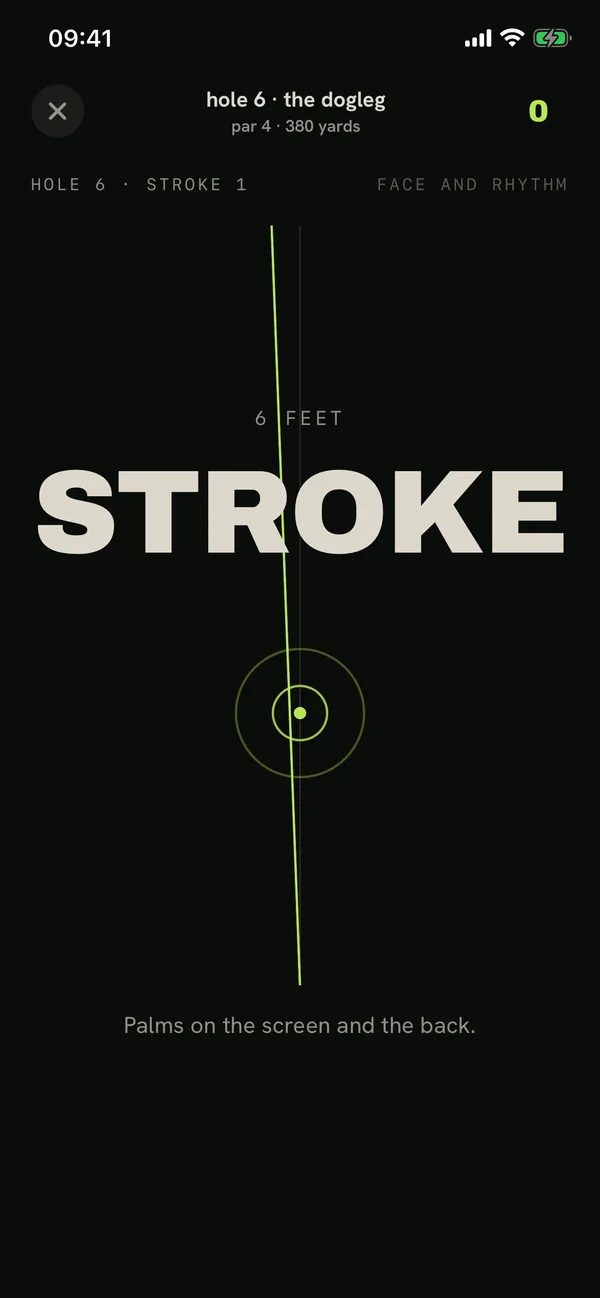
While you stroke, a lime line on the screen moves with the phone's face, so you can watch it stay square or drift. Afterward Rakou reads:
- The phone's face at the ball, in whole degrees open or closed. It is measured against how the phone sat at address, not against a target.
- Backstroke against through-stroke, with about 2 to 1 as the aim.
- How steady the stroke was, which it calls wobble.
- Whether your hands accelerated through the ball, and whether the through-stroke was as long as the back.
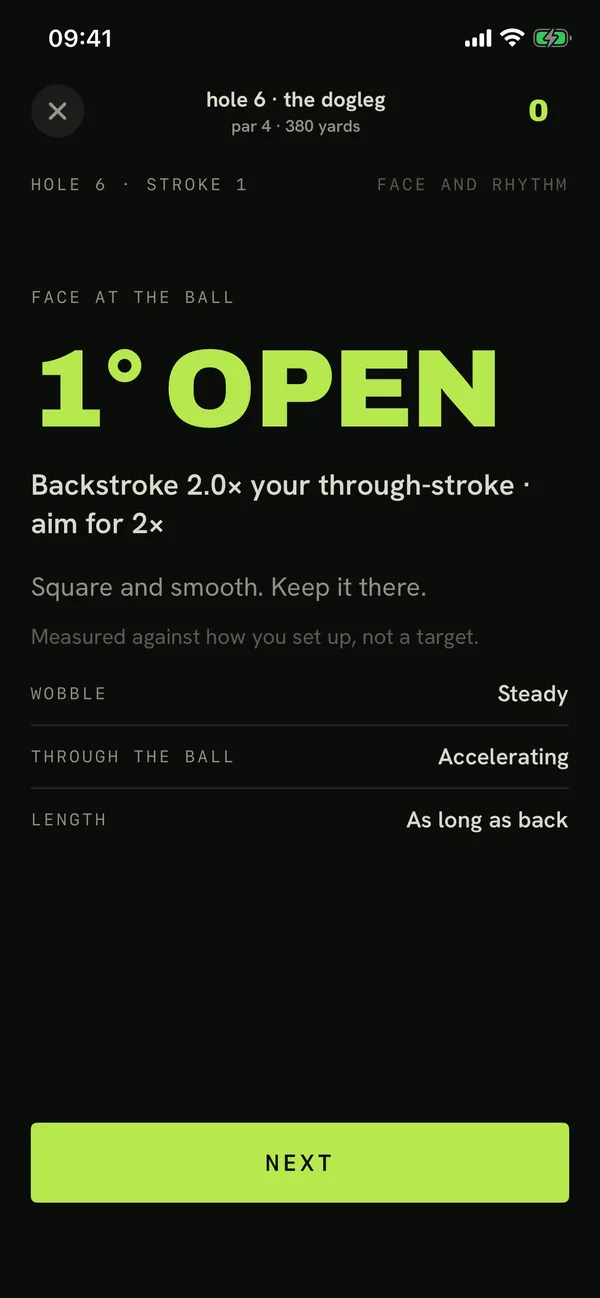
That is a reading of the phone's face, not of a real putter. How far the ball rolls on the hole's green is modeled from how hard you moved the phone, which makes it an estimate, not a measurement. The face and the rhythm are the readings to work on. An optional putting taps setting gives a light tap if the face drifts past 2 degrees during a putt and a firm one past 4, so you can feel a drift without looking.
Rakou also plays full swings, with its own readings for the phone's face, hand speed and tempo. That is covered in swing your phone. The two make a short session: a few swings, then a few putts, in a space the size of a hallway.
The short version
Putting is the cheapest part of the game to improve and the easiest to practice indoors. Square the face, keep a backstroke about twice as long in time as the through-stroke, accelerate through the ball, and keep the stroke steady. Use a gate, a ladder, one-handed strokes and some eyes-closed putts for ten minutes most days, and be straight about what carpet cannot teach: leave the read and the speed for a real green.
Common questions
- How do I do putting practice at home?
- Clear a straight strip of floor, ideally a firm, low-pile carpet, and use a putter and a ball or a coin as a target. Pick a few drills with a purpose: a gate for the start line, a ladder of targets for distance, and eyes-closed strokes for feel. Ten focused minutes beats an hour of aimless rolling.
- What are the best putting drills at home?
- The gate drill, where you putt through two coins or tees set just wider than the ball, trains the face and the start line. A ladder drill with targets at different distances trains speed. One-handed strokes and eyes-closed putts train feel and a steady stroke.
- How do I practice putting indoors without a putting mat?
- Use any flat floor with a clean, consistent surface. A short-pile carpet works, and a hard floor works if you accept that the ball will roll much faster. A coin, a cup or a rolled sock makes a fine target. Stick to one surface so your feel for speed stays consistent.
- What is the right putting tempo?
- For most golfers the backstroke takes about twice as long as the through-stroke, a ratio of roughly 2 to 1. The three to one figure is for the full swing, not the putter. A smooth stroke that keeps accelerating matters more than matching the number exactly.
- Does putting practice on carpet carry over to the course?
- The stroke does, and the feel for speed only partly. Carpet is usually quicker or slower than the greens you play, and it has no slope or grain. So use home practice for the stroke and a real green for reading breaks and judging speed.
- Can a phone help with putting practice?
- It can read the stroke. In Rakou you hold the iPhone flat between your palms and putt. It reads where the phone's face pointed at the ball, the backstroke against the through-stroke, how steady the stroke was, and whether your hands accelerated through. It does not read your putter or a real ball, and the roll on the hole is an estimate.

Putt with your phone tonight
Hold it flat between your palms, count down, and read your stroke.