How to increase swing speed at home this winter
Winter is when most golfers lose speed and when the best golfers add it. You cannot hit a ball into the frozen dark, but you can swing fast, and speed is trained by swinging fast, not by hitting balls. This is how swing speed actually goes up, a plan that fits a living room or a garage, and how to make sure the speed you build still finds the middle of the club in spring.
Why speed is worth training
Distance is not everything, but it makes everything easier. A common rule of thumb is two to three extra yards of driver carry for every mile per hour of clubhead speed, provided the strike stays in the middle of the face. Ten yards off the tee means a shorter club into every par four, and a shorter club is a straighter one.
Speed also fades with age and with time off. A golfer who does nothing from November to March usually starts spring a little slower than they finished autumn. Training speed in winter is partly about gaining and partly about not losing.
Where swing speed comes from
Speed is not made by the arms. The arms deliver it. It is made from the ground up, in a sequence:
- The legs push against the ground. Good players load into the trail side and then push into the lead side, which is where much of the power starts.
- The hips turn, then the chest, then the arms. Each part speeds up and then slows down so the next one can go faster. That handoff is the sequence.
- The hands and the club release last. If the arms fire first, the bigger muscles never get to contribute and the club runs out of speed before the ball.
So a faster swing usually comes from three things: a body that can turn, legs that can push and a sequence that lets each part add to the last. Tension works against all three. A tight grip and stiff arms are slow, which is why swinging harder often makes a golfer slower.
The principle: to go faster, swing faster
Speed is a skill as much as a strength. The body has to practice moving fast to learn it, which means the reps have to be at full effort, with rest in between, and in small numbers. Fifty swings at 80 percent train a comfortable swing. Ten swings at full effort, with a breath between each, train a fast one.
That is also why most speed programs alternate weights. Swinging something lighter than a club lets the body move faster than it normally can. Swinging something a little heavier asks it to produce more force. Swinging your normal club or a normal weight in between connects the two to the swing you actually use.
A winter speed plan for home
Three sessions a week, about fifteen minutes each, for six to eight weeks. You need a clear space with nothing in the arc, something light to swing, such as an alignment stick or a driver held by the head with the grip end swung, and your normal driver if the ceiling allows it. If it does not, a garage or a garden works.
- Warm up for three minutes. Arm circles, slow trunk turns with your hands on your chest, and ten half-speed swings. Never swing fast cold.
- Light, five swings each side. Swing the light object as fast as you can, making a whoosh as low and late as possible, past where the ball would be. Then make five from the other side, left-handed for a right-handed golfer. It balances the body and trains the sequence from a fresh angle.
- Normal, five swings. Your usual club or weight, at full effort, holding your finish each time.
- Rest between every swing. Ten to fifteen seconds. Speed work is quality, not volume.
- Two rounds of the above, then stop. If your swings start getting slower or sloppier, stop early. Tired swings teach the wrong thing.
On the days in between, two or three exercises are worth more than any gadget: split squats or step-ups for the legs, a few jumps for the push off the ground, and trunk rotations for the turn. Ten minutes is enough. And the shoulder turn matters here too: a turn that slides instead of rotates leaks the very speed you are building.
Speed that stays on the clubface
The trap with speed training is building a swing that is fast and wild. Speed is only worth having if two things survive it:
- Your tempo. A faster swing should keep the same proportion, roughly three to one, backswing to downswing. If trying to go faster makes you rush the top, the speed usually comes from the arms, not the body.
- Where the face points at impact. A fast swing that arrives with the face open hits a faster slice. More on that in how to stop slicing.
So alternate. Spend part of each week swinging as fast as you can, and part swinging at a speed you can control, checking that tempo and face hold up. The second kind of session is what turns gym speed into golf speed.
Measuring speed at home
A launch monitor or a swing speed radar gives you a number in miles per hour. Some cost less than a round of golf, and they are worth having if speed is your project for the winter. Record a baseline before you start and check it every couple of weeks.
Without one, there are other measures. The whoosh of a light stick should get louder and later. Your finish should get more balanced at the same effort. And when spring comes, the number that matters is the carry of your driver on a real range.
Reading your speed with your phone
In Rakou the phone is the club. You hold the iPhone like a grip, make a real swing, and the ball flies across one of its 18 holes. One of the readings on every full swing is how fast your hands moved against your own usual swing, as a percentage such as 96% or 104%. That is what decides how far the ball goes in the game.
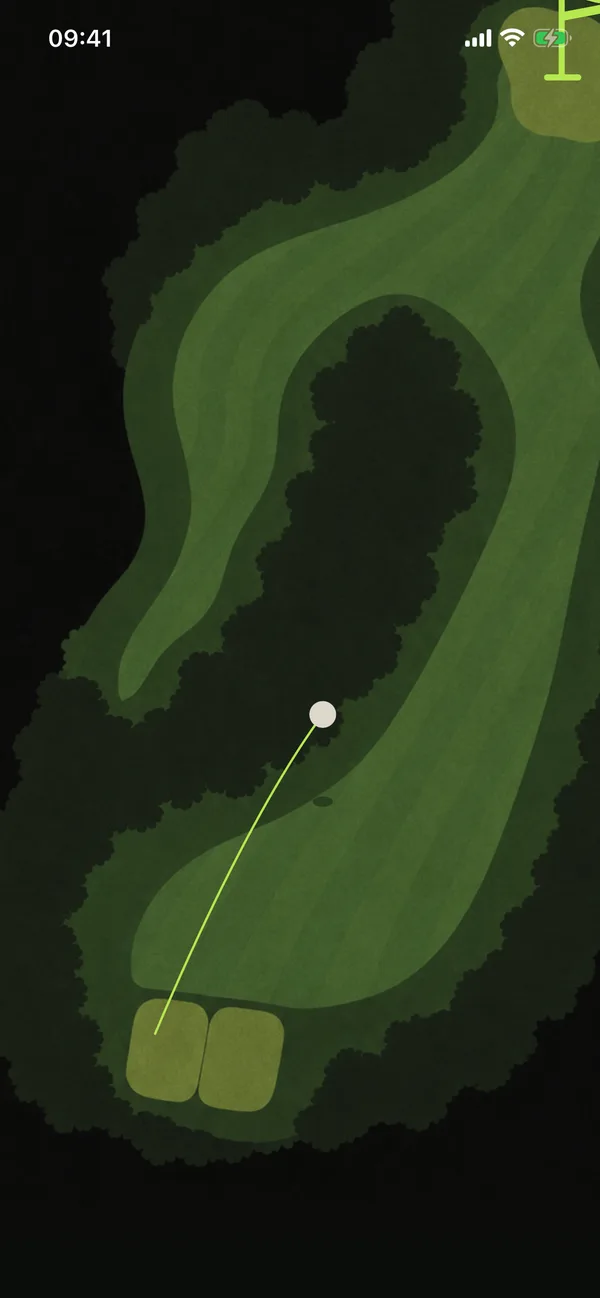
It is deliberately not miles per hour and not clubhead speed. A phone in your hands cannot know either, so Rakou does not invent them. What a percentage of your usual is good for is exactly the question above: can you swing faster than your usual and keep your tempo near three to one and the phone's face near square? Every swing shows all three side by side.
Two cautions. A phone is not a speed training tool: swing it at a speed your hold can trust, with a case on and nothing in the arc. And very fast swings can go beyond what the phone's gyroscope can read. When that happens, Rakou tells you rather than guessing. More on what it reads in swing your phone.
The short version
Swing speed goes up when you swing fast, often, with rest. Three short sessions a week of light and normal swings at full effort, from both sides, plus a little leg and rotation work, is a winter plan that fits indoors. Keep checking that your tempo and the face hold up as the speed rises, because a faster miss is still a miss. Then take the number to a real range in spring. Pair this with the rest of your winter golf practice.
Common questions
- Can you increase golf swing speed at home?
- Yes. Speed is trained by swinging fast, often, with enough rest between swings, and none of that needs a ball. A few short sessions a week of fast swings with a light and a normal weight, plus some rotation and leg strength, is enough for most golfers to see a gain over a winter.
- How much distance does swing speed add?
- A common rule of thumb is roughly two to three yards of driver carry for every extra mile per hour of clubhead speed, as long as the strike stays centered. A faster swing that hits the toe can go shorter than a slower one hit in the middle.
- How long does it take to increase swing speed?
- Most speed programs run for six to eight weeks, with three short sessions a week. Gains tend to come early and then level off, and they fade if you stop entirely, so a lighter maintenance session once a week keeps what you built.
- Does overspeed training work?
- Swinging something lighter than a club, so your body can move faster than it normally does, is the idea behind most speed programs, and many golfers do gain a few miles per hour from it. Results vary, and the gain only reaches the course if the strike and the face stay under control.
- Is it safe to swing fast indoors?
- Only with something you can hold securely and in a space with nothing in the arc. Warm up first, start at half speed, and build up. If you swing a phone, use a case and never swing faster than your grip on it.
- Does Rakou measure swing speed?
- It measures how fast your hands moved compared with your own usual swing, shown as a percentage such as 104% of your usual. It never shows miles per hour or clubhead speed, because a phone in your hands cannot know either. When a swing is too fast for the phone's gyroscope to read fully, it says so.

See your speed against your usual
Swing your phone and read your hand speed, tempo and face on every shot.